|
THE HISTORY OF
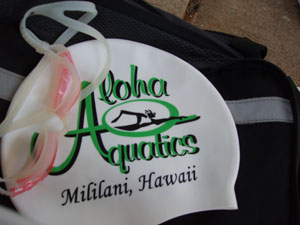
ALOHA AQUATICS
Aloha Aquatics can trace its proud roots to
1971, when the then Mililani Swim Team first took to the water at
Mililani Town’s Recreation Center 1. The team was assembled
by its first coach, Edna Smith. Coach Edna’s objective was to
provide children residing in Mililani with an organized
recreational activity. The team was granted membership in the
Amateur Athletic Union (AAU), the national governing body of all
amateur sports, and with that, swimming officially became the first
organized sport in Mililani.
Between 1971 and 1974,
Mililani Town grew rapidly and so did the team. With the expansion
of the community, Recreation Center 2 was built for the
purpose of providing a competitive training facility for the swim
team. During this time period, Julie VanDyke became the
team’s second coach. Swimming became very popular in Hawaii
and the team grew to over 100 swimmers. Although Mililani was a
young team compared to other teams in Hawaii, its future looked
bright.
In 1974-75, Coach Julie departed, and a new
coach was sought. At the time, Kerry Kamisato was coaching a swim
team in Wahiawa and was offered the enviable position in Mililani.
In order to avoid making a choice between Wahiawa and Mililani, a
merger of the two teams was proposed and adopted. The new team was
called the Wahiawa-Mililani Marlins Swim Club.
The Marlins Swim Club was a huge success
with groups training at Rec 1, Rec 2, and Wahiawa pools. The team
numbered over 130 swimmers and ranked as high as third in the
State, behind powerhouses Punahou and Aulea. In the late
1970’s, the team was forced to leave Wahiawa pool and moved
its top group to Rec 2.
In 1980, an idea surfaced between the
coaches of Aiea Swim Club (Len Limahai), Kahului Aquatics (Ed
Tamura), Hilo Aquatics (Ed Kawachika), and the Marlin Swim Club
(Kerry Kamisato), to combine "forces" to provide their swimmers a
sense of unity and camaraderie when competing on the mainland. To
identify the team with Hawaii, the name Aloha Aquatics was
born.
During the 1980’s, Aloha Aquatics
surpassed all of the coaches’ dreams. It gave swimmers and
parents a chance to share and experience great times with others
from the neighboring islands. Team outings, such as the annual
Memorial Day Maui camp, were events which everyone eagerly looked
forward to. The swimmers were highly motivated and excelled beyond
expectations, claiming the top spot at several State
Championships.
Emerging from the high of the ‘80s
and into the ‘90s, many changes began taking place within the
organization. Coaching changes at Aiea, Maui, and eventually the
Big Island, changed the makeup of Aloha Aquatics. Aiea, Maui, and
the Big Island re-established their independence. In 1999, Kerry
Kamisato moved to the Big Island and Ron Tsuchiya became Aloha
Aquatics’ head coach. After Coach Ron’s departure in
2004, Lauralee Kawamata took over as interim head
coach.
Throughout the Mililani, Marlin, and Aloha
Aquatics eras, the team’s success has been proven by its many
records which still stand today. The 1979 Marlin team holds the
13/14 girls 200-meter medley relay record. The 10 and under boys
have held relay records since 1981. The Aloha Aquatics 15/16 and
senior girls have 200-meter free and medley records, as well. The
relay records reflect the depth and talent of a team, as well as
individual efforts. There have been many swimmers from our program
who have left their individual marks in the State record books,
some of which still remain unbroken. Our swimmers have competed at
all levels from State Championships, Western Zones, Junior National
Championships, National Championships, and even, for former Aloha
Aquatics swimmer and Mililani High School graduate, Keiko Price,
the Olympic trials.
Over the years, Aloha Aquatics has
continued its drive to develop young swimmers into globally-minded
athletes, that appreciate the value of hard work, discipline, and
community. Its world-class coaching staff has included a succession
of amazingly talented and caring mentors, including: Craig Whang,
former Chinese Olympic swimmer Ying Juan Zhen, former University of
Hawaii head coach Mike Anderson, Randall Folker (understudy to
former Olympic coach Bill Rose), and Dustin Fukuda. Our current
coaches, Travis Suemori, Kenneth Fukada, and Sean Yamada, continue
this tradition of excellence.
As Mililani has grown and evolved, so have we. In
2012, due to Rec Center renovations, our primary training grounds
shifted to the Veterans Memorial Aquatic Center, in Waipahu. Our
organization never forgot its roots, however, and in 2017, we
proudly announced the return of our Bronze and Silver groups to
Mililani Rec Centers 1 and 6. We’ve truly come full circle,
and we’re excited to launch the next chapter of Aloha
Aquatics… with you!
Tri-fold brochure with general info [click
here]
Welcome Letter: additional information
including monthly dues and fees
[click here]
|